
Revisiting Tools for Change: Reflections on Methodologies and Desire-based Approaches in Roma-related Research
Main Article Content
Article Sidebar
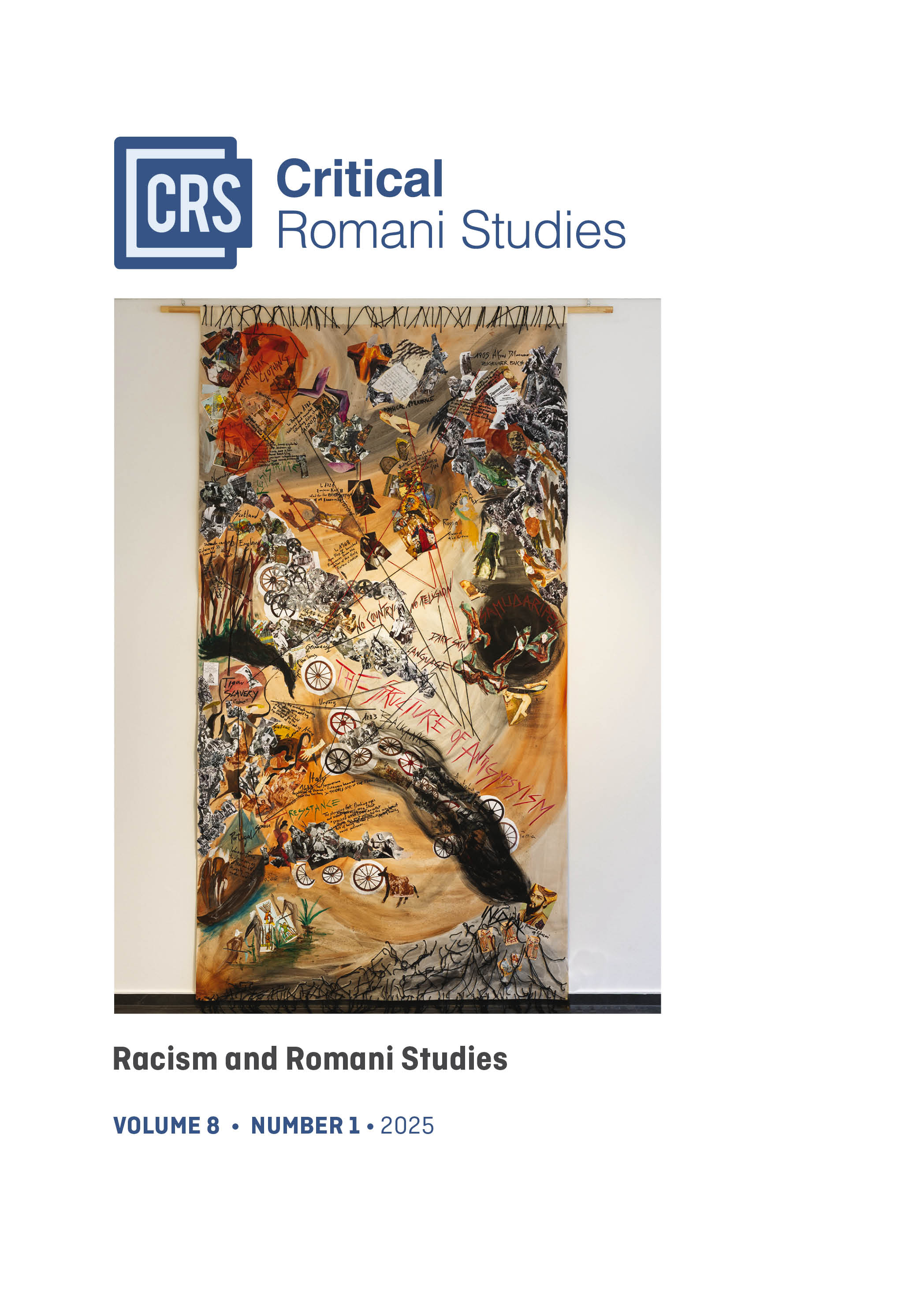
Published
Dec 11, 2025
Sanni Matleena Lindroos
Abstract
In this article, I revisit some of the main critiques, questions and suggestions in relation to methodological approaches emergingalongside the discipline of Critical Romani Studies. Drawing from Indigenous Studies scholar Eve Tuck’s notion of desire-basedresearch, I apply the three goals that Tuck set to foster emancipatory methodologies as a framework to reflect on the strengths andlimitations of previously proposed methodologies in Romanirelated research. By establishing counterhistories of Roma, Romanischolarship, a reconfiguration of the archive, and reflections on critical whiteness as the main topics in the epistemological paradigmshift unfolding over the past decade, I suggest some further points for methodological consideration that could advance the discipline.In particular, I discuss the possibility of co-researching as a mode of participatory knowledge production and propose digital platforms as a potential site of research, as well as call for further reflections on how to make research results more accessible to wider audiences.
How to Cite
Lindroos, S. M. (2025). Revisiting Tools for Change: Reflections on Methodologies and Desire-based Approaches in Roma-related Research. Critical Romani Studies, 8(1), 222–233. https://doi.org/10.29098/crs.v8i1.232
Article Details
Keywords
Methodology, Authorship, Archive, Counterhistories, Paradigm Shift, Desire-based approach
Section
Arts and culture

This work is licensed under a Creative Commons Attribution-NonCommercial 4.0 International License.
Authors who publish with this journal agree to the following terms:
- Authors retain copyright and grant the journal right of first publication. The work is licensed under a Creative Commons Attribution-NonCommercial License that allows others to share the work with an acknowledgement of the work's authorship and initial publication in this journal.
- Authors are able to enter into separate, additional contractual arrangements for the non-exclusive distribution of the journal's published version of the work (e.g., post it to an institutional repository or publish it in a book), with an acknowledgement of its initial publication in this journal.